
Introduction
If you have noticed your child engaging in play that involves sexual themes—such as "having sex with Barbie"—with your first instinct might be one of shock, confusion, or concern. You may wonder if they are being influenced by outside media, if they are "acting out" something they shouldn't know, or if you have failed to set proper boundaries. The direct answer is that this behavior is a normal, expected part of childhood development. For most children, this type of play is not about actual sexual intent in the adult sense; rather, it is a way of processing complex ideas about bodies, gender roles, and human connection using a safe, imaginative proxy.
Children explore the world through play. Just as they might pretend to drive a car, cook a meal, or run a "store," they eventually begin to experiment with the "grown-up" concepts they observe in their environment. When a child engages in sexualized play with a doll, they are often navigating the transition from a world of simple play to a more complex understanding of what it means to be a human being with a body. Understanding this developmental milestone can help parents move from a place of anxiety to a place of informed, supportive guidance.
The Developmental Logic of Symbolic Play
To understand why children engage in this behavior, it helps to look at the mechanics of "symbolic play." This is a developmental stage where a child uses an object to represent something else. A block becomes a phone; a cardboard box becomes a spaceship. Psychoanalyst Joyce McFadden suggests that play-acting with dolls serves as a vital tool for girls to imagine adult life [1]. It is a way for them to "try on" different roles, much like a child might try on a mother’s makeup or clothing to see how it feels to inhabit that identity [1].
Sexuality, in this context, is simply another "adult" role or concept to be explored. Because children are growing in all areas—academic, creative, and physical—it is natural that sexual development follows a similar "step by step, day by day" progression [1]. They are not skipping ahead to adulthood; they are slowly incorporating the various facets of human life into their internal maps of how the world works.
How Play Functions as a Safe Buffer
Toys like Barbie provide a unique "buffer" between a child's imagination and reality. The physical design of these dolls often communicates the boundaries of what is considered socially acceptable. For example, many Barbie dolls feature breasts but have "censored, flat pubic regions" [1]. This specific design sends a message to the child: sexuality is an adult topic that is recognized but restricted. It allows the child to explore the concept of intimacy within a framework that maintains a clear distinction between the "safe" world of play and the "restricted" world of adult reality.
The Spectrum of Childhood Exploration
It is important to understand that there is no single way children "play sex." The behaviors can vary wildly depending on the child's age, personality, and what they have observed in their environment. These behaviors typically fall on a broad spectrum of exploration:
- Physical Imitation: This may include "dry-humping" or "make-out" scenes where the child is mimicking the physical motions of intimacy they may have seen in movies or between adults.
- Role-Playing: The child may focus on the relational aspects, such as the dolls "going on dates," "getting married," or "moving in together," focusing on the narrative of partnership.
- Abstract Fantasy: Older children may engage in more complex fantasies involving "full sex" or specific anatomical explorations, moving toward a more literal interpretation of adult behaviors.
Because this spectrum is so wide, it is helpful to view these actions as a laboratory for the imagination. The child is testing out different scenarios to see how they "feel" in their own mind. They are often demonstrating an awareness of social boundaries even during this play; many children will perform "safe" activities like driving in front of their parents while concealing more "explicit" scenes of flagrante delicto when they know they are being watched [1].
Sexuality vs. Sexualization: A Critical Distinction
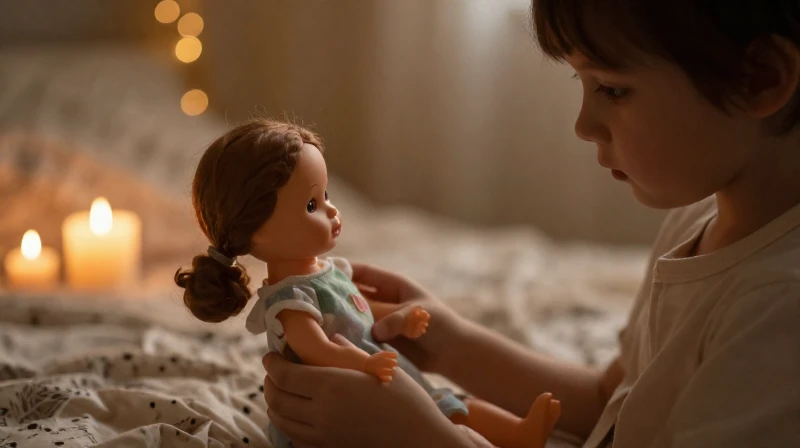
One of the most important concepts for parents to grasp is the difference between a child’s sexuality and the sexualization of children. These are fundamentally different processes with very different implications for a child's development.
| Feature | Childhood Sexuality (Developmental) | Sexualization (Adult Gaze) |
|---|---|---|
| Source | Internal: Driven by curiosity and imagination. | External: Driven by media, marketing, and adult perspectives. |
| Goal | Understanding bodies, roles, and human connection. | Objectification, performance, and consumption. |
| Context | Safe, symbolic play (e.g., with dolls). | Hypersexualization of girls in media (e.g., swimsuit issues). |
| Impact | A healthy, normal part of the human life cycle. | Can lead to a distorted view of self-worth and body image. |
When a child plays with dolls, they are engaging in sexuality—a normal and healthy part of the human life cycle. They are using Barbie as a unique space for early fantasies, perhaps because she was the only doll available that included certain anatomical features like breasts [1]. However, when dolls are sexualized by adults in media—such as in certain types of advertisements or publications—the context shifts. That is sexualization, where the doll is no longer a tool for a child’s internal development but a product of the adult male gaze [1].
How to Respond as a Parent or Caregiver
The goal of parental involvement in this situation is not to shame the child or "shut down" their imagination, but to provide a safe environment where they can move toward a healthy understanding of bodies and boundaries. If you encounter your child engaging in sexualized play with dolls, consider these practical steps:
- Remain Calm and Neutral: Your reaction is the most important factor. If you react with horror, shame, or anger, the child may learn to hide their curiosity rather than exploring it openly. If you remain calm, you maintain a "safe harbor" for them to come to you with questions.
- Observe the Narrative: Instead of focusing solely on the physical actions, listen to the "story" the child is telling. Are they playing out a wedding? A first kiss? A long-term relationship? This gives you a window into what concepts they are trying to understand.
- Provide Accurate, Age-Appropriate Information: If the child asks questions about what the dolls are doing, answer honestly but simply. Use correct anatomical terms. For example, if they ask about how babies are made, give a simple explanation that fits their developmental level without being overly graphic or dismissive.
- Model Healthy Boundaries: Use these moments to reinforce the idea that sex is a private, consensual activity between adults. You can say things like, "That's a big grown-up topic. In our family, we talk about these things with respect and privacy."
- Encourage Variety in Play: While exploration is normal, you can also gently broaden the scope of play. Encourage the dolls to have adventures, careers, and hobbies, ensuring that their "lives" are multi-dimensional and not solely defined by sexual themes.
Synthesis: Navigating the Path Forward
Watching a child engage in sexual play with dolls can feel like a jarring intrusion into their childhood, but it is important to remember that this is a standard developmental milestone. Children are naturally curious about the mechanics of life, and toys provide the safest possible arena to test those theories. By distinguishing between a child’s healthy, internal exploration of sexuality and the external pressures of societal sexualization, you can navigate these moments with confidence.
The key takeaway is that your child isn't doing something "wrong"—they are learning. Your role is to be a steady, non-judgmental guide. By remaining calm, providing clear information, and fostering an open line of communication, you ensure that their natural curiosity leads to a healthy, respectful understanding of their own bodies and the bodies of others. If you ever feel overwhelmed or unsure how to handle specific questions as they arise, consulting a child psychologist or a pediatric sex educator can provide tailored support for your specific family dynamic.
This article provides sexual education for informational purposes and is not a substitute for professional medical advice, diagnosis, or treatment.
Sources
- My Barbies Had So Much Sex. It Was Great. — thecut.com
Related Articles